Shakespeare Festival is set and ready to go
Production has a bit of comedy and humour for all to enjoy
By Nathan Willard
PRESCOTT - Craig Walker will direct the play Twelfth Night, which opens on Friday July 8th. He will be infusing the play with an Irish flavour – audiences will enjoy lots of toe-tapping Celtic music mixed with uproarious laughter.
This year’s festival will see the return of Artistic Director Ian Farthing who will be playing the role of Malvolio in Twelfth Night. It took very little arm-twisting to get Farthing to play a main character in this playlist.
“Director Craig Walker would only direct this play if I played the character Malvolio,” said Farthing. “Things worked out well for me because I have always wanted to play the role of Malvolio… it was one of the characters left on my bucket list.”
Walker was equally as excited to be working with Farthing also.
“One of the reasons I wanted to do this play at this time was the presence of Ian Farthing”, said Walker. “Malvolio is probably the touchstone character of the play, and Ian’s ability to be very funny combined with the ability to move from authority to wounded dignity with extreme vulnerability makes him ideal casting for this role”.
Janet Irwin will be directing the other Shakespeare play, All’s Well That Ends Well. It opens up on Tuesday July 12th. It is set in a magical fairytale land where the heroine must rely on more than just magic to win her happily ever after story ending.
“This play [All’s Well that Ends Well] will be a good contrast and counter balance to Twelfth Night,” said Farthing.
For those who attended last year’s festival, you will see some familiar faces as some members of the cast are coming back to help with both productions. Amongst those returning to this years festival will be Kerry Ann Doherty, Warren Bain and Quincy Armorer. New faces to the festival will include Canadian Idol finalist Elena Juatco and recent St. Lawrence College Music Theatre graduate Dan Thompson.
There are three new initiatives for the 2011 St. Lawrence Shakespeare festival. The first major change will include a Wednesday matinee each week.
The second change will be the creation of a ‘pay what you can preview.’ The pay what you can preview will be on July 8th and 12th.
“Although our ticket prices are very reasonable, we know there will always be people who still can’t afford to go. We want to make Shakespeare available to all, regardless of financial circumstance, and this is one way for us to enable that,” said Farthing.
Finally, the Festival will host a ‘Tuesday Talk’ session that will start every Tuesday at 6:30 p.m. Audience members will be able to sit down with the actors and be given a brief 15-minute introduction to the play where you can learn more about the story, the characters and the theme of the play. You may also be able to learn about the “behind the scene” gossip that goes on from time to time.
Also, like last year, kids under the age of twelve get in for free.
The St. Lawrence Shakespeare Festival has historically been a successful production here in Prescott – and this year looks to be no different. Advance sales are up by 150% over last year’s figures.
“It is encouraging to see such an increase,” said General Manager Rebecca Campbell. “We hope this is a sign of larger audiences to come all the way throughout the summer”.
The festival has grown ever since its inauguration. People from around the area, people who used to live in Prescott, and first-timers continue to flock to Prescott to watch live Shakespearean theatre. This year is shaping up to be no different.
For more information or to book tickets:
Call 613-925-5788 or visit www.stlawrenceshakespeare.ca
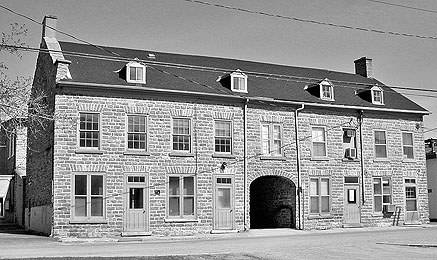
Historical building in Prescott to be sold in July 12 auction
Prescott Journal building believed to be home to the Packet, the predecessor to the Ottawa Citizen
One of the most historically significant buildings in Eastern Ontario is going to be sold via auction.
Two connected buildings on King St. West and Water Street in Prescott, both built in the mid-1800s, will be sold July 12, 2011. The buildings have been the home for the Prescott Journal for more than a century, and the building was believed to be the first home of the Packet, a weekly newspaper that would eventually become the Ottawa Citizen.
The auction is being handled by Gordon’s Estate Services.
The Prescott Journal’s corporate offices have moved to their production and printing facility on County Road 2, about two kilometres east of Prescott.
“There is an incredible amount of history in these buildings,” said Beth Morris, owner of the Morris Group, publishers of the Prescott Journal. Beth’s late husband, John Morris, and her late father-in-law, Jack Morris, were both publishers of the Prescott Journal in the building, and they both published books on the history of Prescott out of the building. “The buildings present a great opportunity to the right person or group.”
The three-storey Water Street building has an historic archway separating the ground floor into two parts. Built in 1851, it was originally an inn and pub called the Duck and Drake, while the Prescott Journal, first published in its present format in 1890, occupied the east side of the building.
Gordon’s recommends the building as ideal for a townhouse conversion.
The three-storey King Street building has been home to the Prescott Journal and its predecessors for more than a century and a half. Among them were the Packet, published by Robert Bell in 1847. Bell would become discouraged with his business and move to Bytown, where he would publish the Bytown Packet. This newspaper would become the Ottawa Citizen.
The Prescott Journal was printed in the building until 1965.
The King St. building and the east side of the Water St. building were joined in 1965 to house a sheet fed printing business. The buildings will be sold together and will need to be separated by lot addition in order to be sold separately.
While being the launching grounds for the Ottawa Citizen is the most unique historical footnote the building has, it has been the hub of a strong newspaper tradition in the Fort Town that dates back nearly two centuries.
The first newspaper published in Prescott was the Grenville Gazette, circa 1816. Donald McLeod, originally from Aberdeen, Scotland and a veteran of the War of 1812 with the British Navy, settled in Prescott and founded the Gazette following his discharge. It was a radical Reform newspaper.
While it is unknown how long the Gazette was published for, it was resurrected in 1831 when a Mr. Miles from Kingston arrived in Prescott with equipment for setting up a printing office. He resurrected the Gazette but became discouraged, and disposed of his office and business to McLeod.
McLeod, an active Reform politician who would eventually move on to Cleveland, OH, would pass on the Gazette to William Wells. A lawyer and a Reform Party representative in the Legislative Assembly, Wells also struggled to make a newspaper work in Prescott. He changed the name of the paper to the Vanguard and continued on the path of being a staunch advocate of Reform principals.
Wells sold the business to a man named Mr. Wilson, who changed the newspaper’s political views from Reform (liberal) to one of conservatism. Wilson eventually sold the company to Robert Headlam.
Robert Bell started as publication called the Packet in 1847 but would move his publication to Bytown after a few months. The Bytown Packet would grow into the Ottawa Citizen.
Back in Prescott, meanwhile, S.B. Merrill arrived from Kingston with his printing equipment and set up shop in the Water St. building. He published the Prescott Telegraph, which was another Reform newspaper and a forerunner of the Prescott Journal. Merrill would eventually pass the newspaper business on to his sons.
During this era of Prescott newspapers, the town also saw the Leeds and Grenville Independent and the Prescott Conservative Messenger come and go. Coincidentally, the Morris Group, who own the Prescott Journal, also have newspapers in their stable by those names in the Barrhaven Independent and the Manotick Messenger.
It is believed that the Prescott Journal and Prescott Telegraph were published concurrently by James Stoddard, and in 1890, the newspapers were combined to form the Prescott Journal and Grenville County Telegraph. The Journal offices were believed to be on the second floor of the building, with Norm Miller’s Book Store occupying the downstairs level. The Telegraph, meanwhile, was published out of the Water St. building at the back of the current Prescott Journal building. The publication, which has survived to become today’s Prescott Journal, stated it was established in 1847, which was the launch year of the Telegraph. This makes the Prescott Journal one of the nation’s oldest newspapers, with its 165th anniversary coming next year.
In 1929, W.E. Crateau purchased the Prescott Journal from the Mason family, leasing the building from them and buying it outright in 1946. He incorporated St. Lawrence Printing in 1949. His editor, Jack Morris, would eventually buy shares in the company. His son, John Morris, bought the Kemptville Advance, and would sell his newspaper to buy Mr. Crateau’s shares and become a partner with his father.
“The building has an incredible history,” said Jeff Morris, who is currently serving as the editor of the Prescott Journal in the footsteps of his grandfather, father and uncle (Robin Morris). “It has been the hub of activity and communication in the town for generations and generations. One of my first memories is sitting at my grandfather’s desk and watching the Centennial Parade on July 1, 1967, from the upstairs window when I was three. It’s a beautiful building and it can play a big part of Prescott’s future linking to its heritage and past.”
For more information on the auction of the buildings, visit www.gordonsestateservices.com.